The software industry needs more Brunels
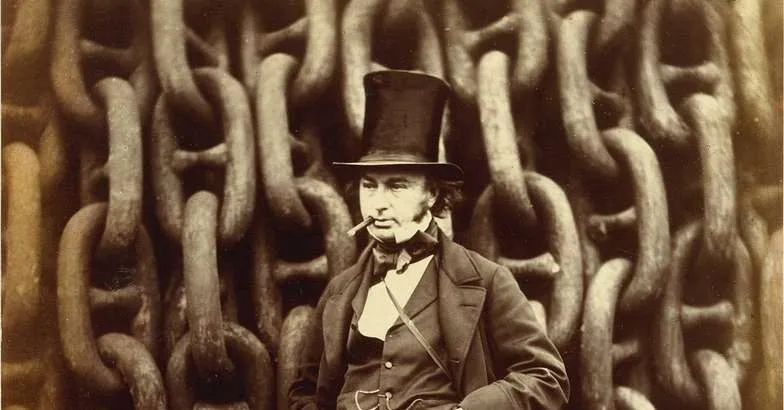
Of all the wonderful feats I have performed, I think yesterday I performed the most wonderful. I produced unanimity among 15 men who were all quarrelling about that most ticklish subject - taste.
After three decades of nodding along to dad saying “did you know Brunel built that…?”, I finally read about the man for myself and was delighted. The scale of work Brunel delivered in his short life is an inspiration.
He built hundreds of miles of rail for the GWR, dozens of bridges, some of the largest ships of his time, and landmark buildings such as London Paddington and Bristol Temple Meads stations. And he accomplished all this over thirty years in the mid 1800s.
I feel Brunel's success with a hands-on, interdisciplinary approach in the much risker domain of 19th century engineering is an inspiration to software builders today. We’re very good at coming up with reasons to discourage us from doing extraordinary things, but the true limit is only the extent of your passion and interest and Brunel is a model in that regard.
It would be [a great advantage] to me as a civil engineer to be better acquainted with geology, as well as with many other branches of science.
The quote above also applies to building good software: a product manager can greatly benefit from learning in computer science, design and business domains. The same thinking applies to any other role. We gain a great deal from learning the other disciplines that we need to build and sell great software.
Learnings from Brunel’s history reinforces that:
- We can be more hands-on than we think regardless of the level we work at and there is great value in doing so
- We should not let our job description restrict our scope to make impactful change
- We should operate with a constant sense of urgency. Momentum is king.
Brunel simultaneously managed to be in the details, from surveying land by horse for the next set of tracks his crew would lay, to challenging contractors on the quality of brick they used for even the smallest bridge, to even picking the fabric that would be on the seats of the GWR carriages (I doubt it is the same fabric today, but my wife remarks that she’s not a fan).
The term ‘Consulting Engineer’ is a very vague one, and in practice has been too much used to mean a man who for a consideration sells his name, but nothing more. Now I never connect myself with an engineering work except as the Directing Engineer who, under the Directors, has the sole responsibility and control of the engineering, and is therefore ‘The Engineer’; and I have always objected to the term ‘Consulting Engineer’.
During the Crimean War (1853-1856), the War office tasked Brunel with designing and constructing a hospital to reduce British deaths from diseases caused by poor hospital conditions. From the initial tasking to the actual delivery of Renkioi Hospital, it took Brunel less than 6 months, and it was a massive success, reducing the fatality rate of the wounded by tenfold from ~40% to 4%.
If Brunel was able to work at pace and across disciplines in the 19th century while building bridges, railways and tunnels where the risk of failure is so much higher - and taught himself whatever each domain demanded, what is stopping us from doing the same in the more malleable software industry, which is much more forgiving to experimentation?
Any part I have taken in examining into the system has been purely from the desire which I always feel to forward good inventions.
If you’d like to read more about Brunel, I recommend starting with Steven Brindle’s Brunel: The Man Who Built the World